Poultry farm reports: ten registers in Excel and PDF
How PoultryOS turns the daily entries, sales and bills of every farm into ten registers on the Owner portal, condensed on the phone, each with filters, grouping, Excel and PDF, plus the costing report of one batch day by day.
PoultryOS Team · Product and implementation team
Every integrator keeps registers; the question is how many hands they pass through first. A supervisor writes the day in the farm record book, the branch types it into a sheet, the accounts team keeps a second sheet for the bills, and at the month end somebody tries to make the two agree. In contract broiler farming that delay costs real money, because the farm that is slipping and the customer who is not paying both look fine on last month’s sheet. PoultryOS, a poultry ERP built around the batch, reads its registers from the records the farms and the office already make: the daily entry, the sale slip, the bill and the growing charge statement. Nobody types a register.
Here are the registers of the sample organisation, Shree Agro Integration, with figures read from its screens.
Poultry farm reports on the phone: condensed, as PDF
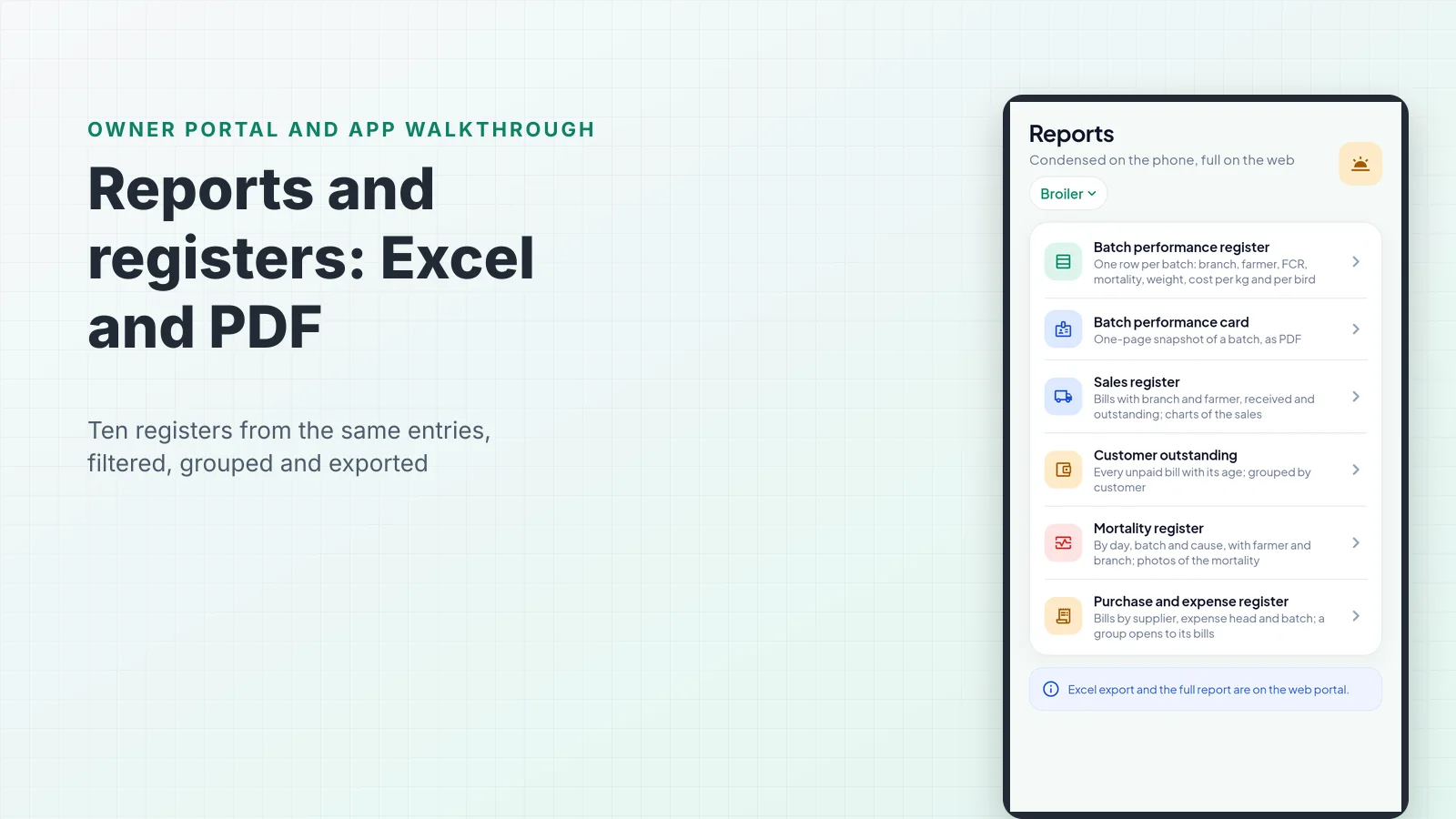
The owner’s phone has a Reports tab in the bottom bar. It holds six reports: the batch performance register, the batch performance card of one batch as PDF, the sales register, customer outstanding, the mortality register and the purchase and expense register. The pill at the top switches the module, so the same tab serves Broiler, Layer and Breeder.
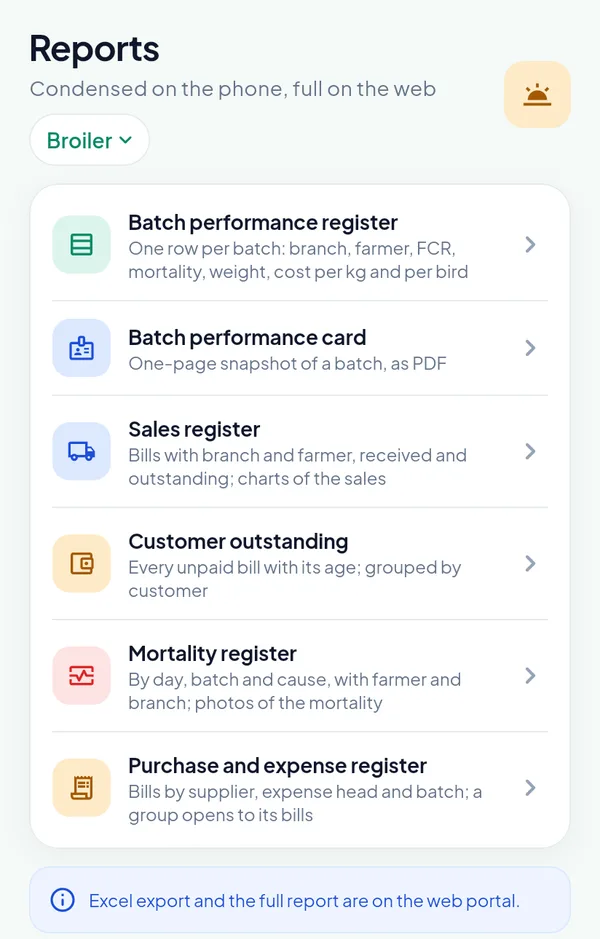
Six reports on the phone. The share icon of each saves it as PDF; Excel waits on the portal.
Condensed on the phone, full on the web: the phone is for reading a register in the shed and sharing it as a PDF with the logo; filters, grouping and Excel live on the Owner portal.
Ten registers on the Owner portal
The Reports page of the portal lists the registers as chips across the top: batch performance, sales, customer outstanding, other sales, mortality, storage analysis, profit and loss, purchase and expense, growing charges and feed stock. Next to these ten sit the costing report of one batch and three reports of the supplier bidding: the RFQ register, supplier participation and the item price trend.
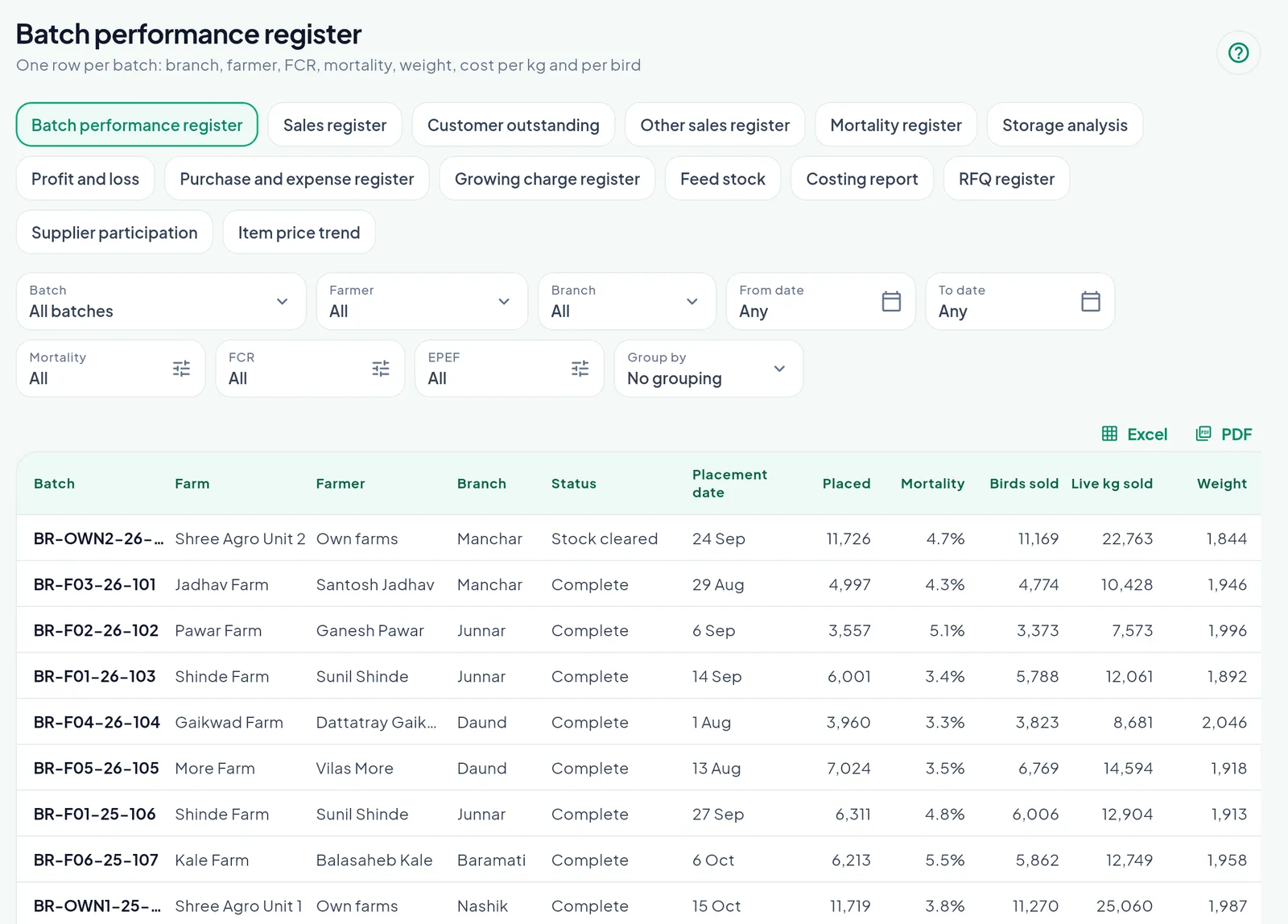
One row per batch, with the filters above it and Excel and PDF at the top right.
Every register follows one pattern. The filter boxes come first: batch, farmer, branch, from date and to date, and then the filters of that register. The batch performance register adds Mortality, FCR and EPEF as range filters; each opens a panel with a slider of two handles and the fields From and To, so “every batch with an FCR above 1.70” is two clicks. Group by folds the rows by farmer or branch: one line per group with its totals, and a click on the line opens its rows in place.
The figures of a group are weighted. The FCR of a branch is all its feed over all its kg, its mortality all its birds lost over all its birds placed.
The same register on the phone shows each batch as a card in the colours of its rating.
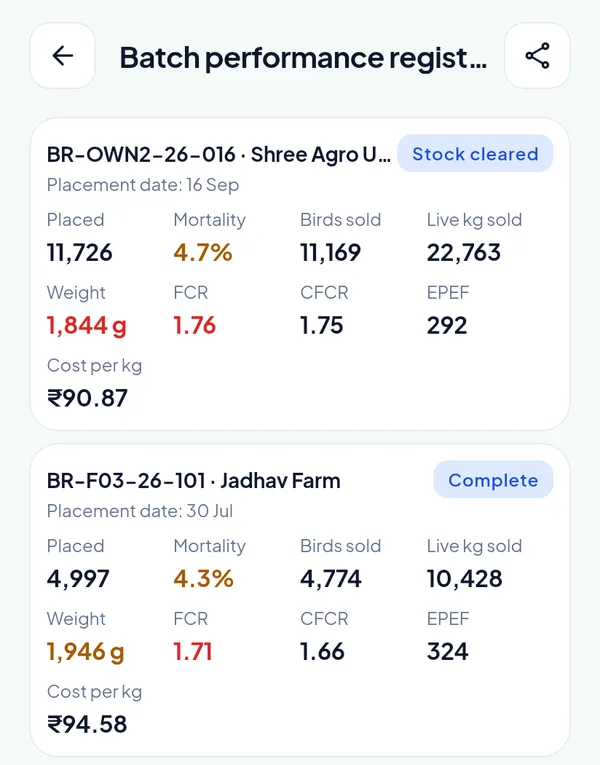
BR-OWN2-26-016 sold 22,763 kg at an FCR of 1.76 and an EPEF of 292; the colours rate each figure against the standard.
The sales register, by customer
Group the Sales register by customer and the whole sales book of the sample organisation fits on four lines.
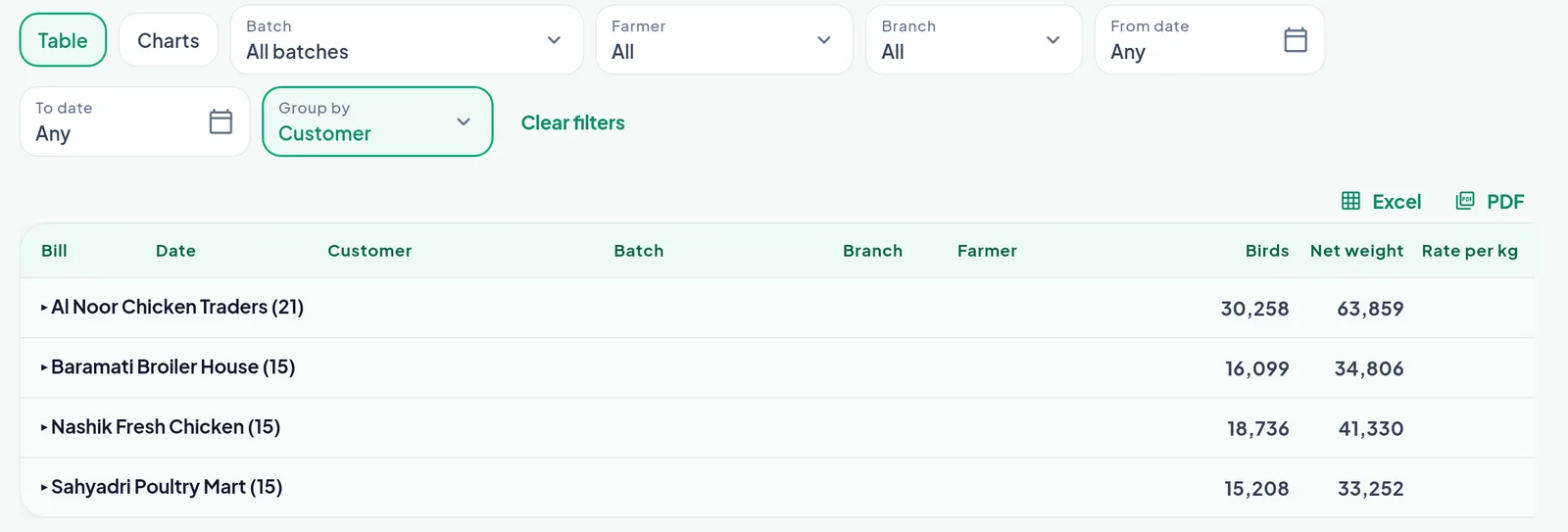
66 bills, 80,301 birds and 173,247 kg, in four customers.
Al Noor Chicken Traders took 21 bills, 30,258 birds and 63,859 kg: more than a third of the kg on this screen. It also groups by farmer or branch, and the grouping travels in the address, so a bookmark opens the same view tomorrow. Charts beside Table compares the customers and the branches, draws the sales over time and the weight at sale, sets our sale rate against the market rate of a city, and splits the outstanding by the age of the bill.
Without grouping, each bill is a row: the bill number, the date, the customer, the batch, the branch, the farmer, the birds, the net weight and the rate.
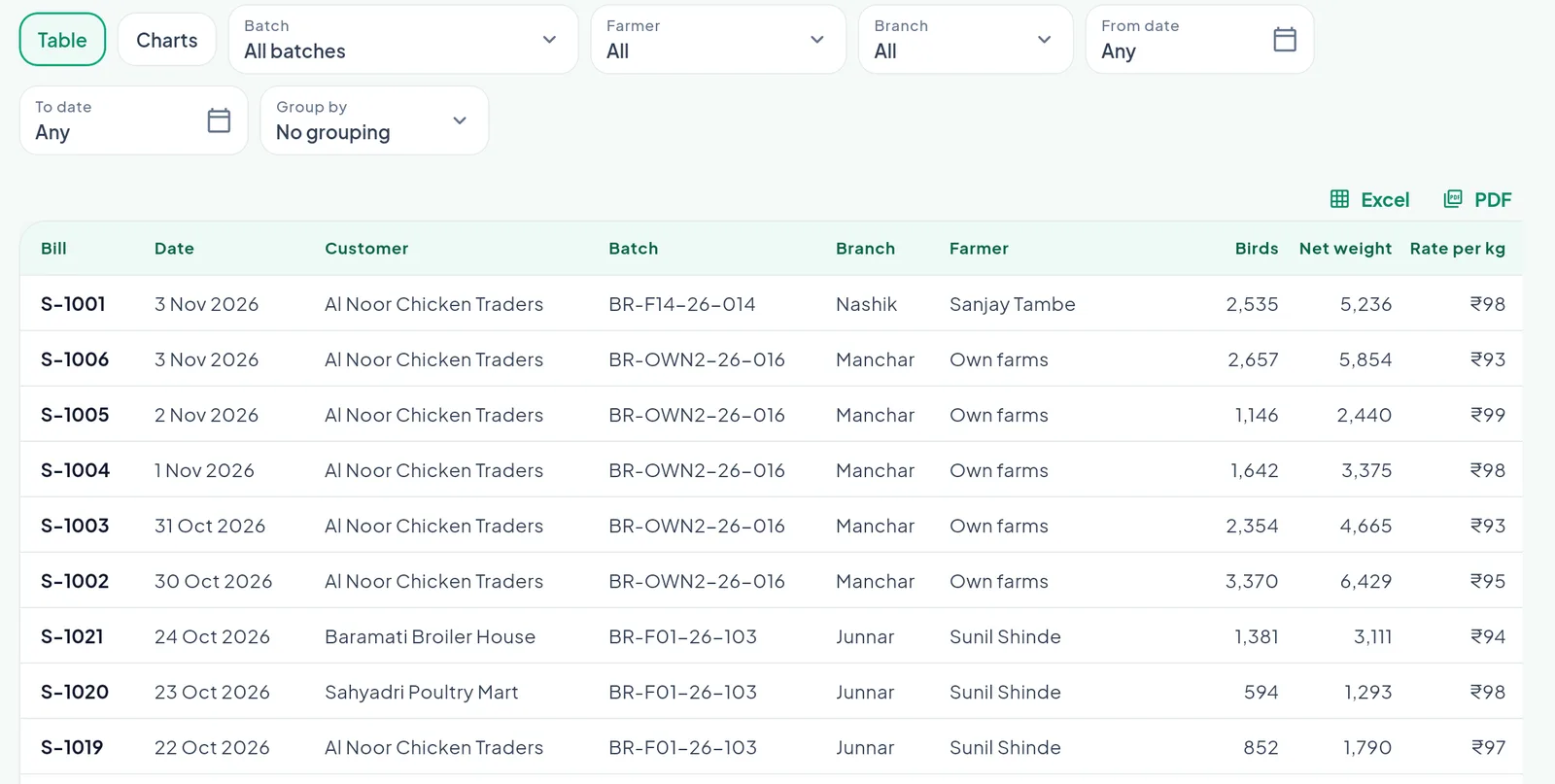
Bill S-1001: 2,535 birds and 5,236 kg from Tambe Farm at ₹98 a kg. We meet it again in the costing report below.
A click on a row opens the bill in a dialog: the gross, tare and net weight, the rate, the vehicle, the weighbridge slip, the receipts, and the buttons Bill PDF and Open batch. Customer outstanding and other sales open their rows the same way.
Customer outstanding: who owes what
The outstanding register answers the question an owner asks every morning. On the phone it is one line per customer.
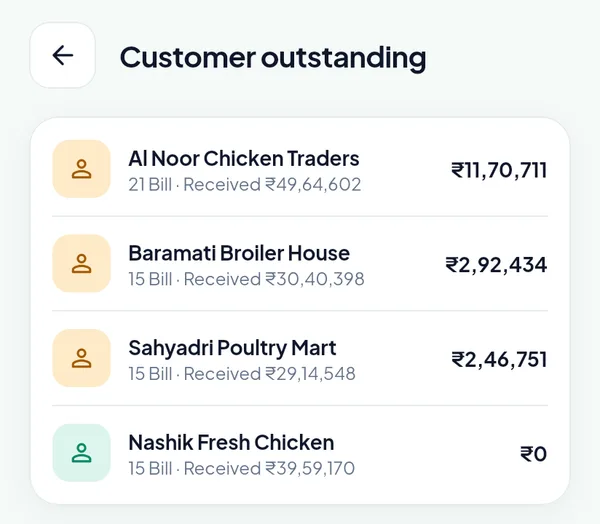
₹17,09,896 outstanding in all, and ₹11,70,711 of it with one customer.
Here is the worked example. Al Noor has been billed ₹49,64,602 received plus ₹11,70,711 outstanding, ₹61,35,313 in all, so about 19 % of its bills are unpaid. Nashik Fresh Chicken has paid every one of its 15 bills. Al Noor also holds 68 % of everything the organisation is owed. On the portal the register lists every unpaid bill with its age, amber over 15 days and red over 30, so the call to Al Noor starts with the oldest bill, not with a total.
Mortality, by day and cause
The mortality register shows the last 14 days on the phone, by batch, day and cause, with the high days in red.
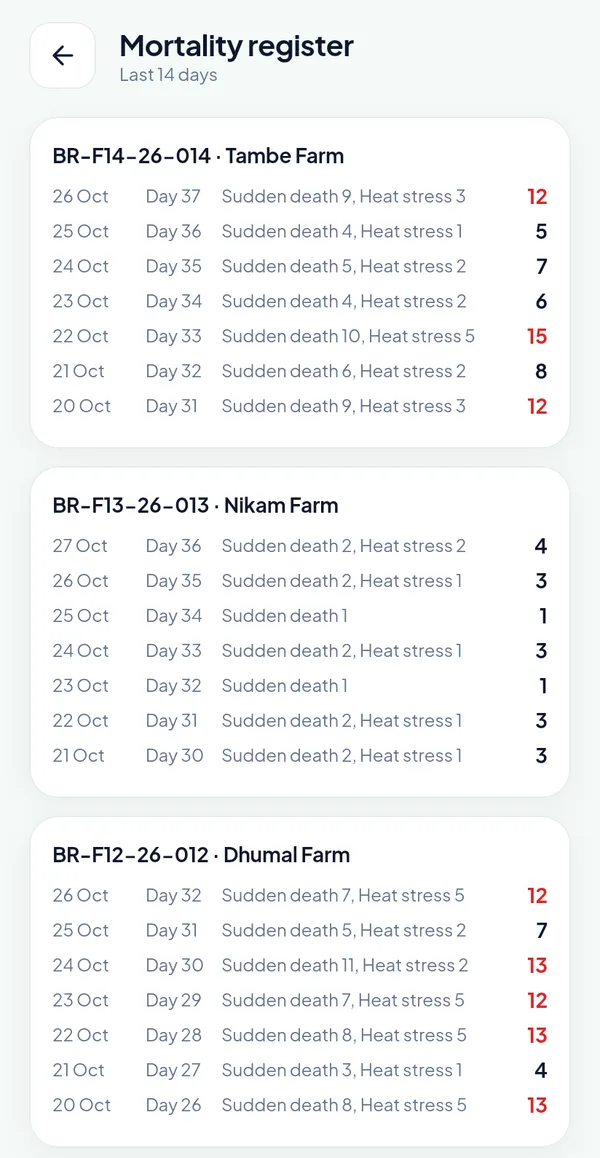
Heat stress on every day of Tambe Farm and Dhumal Farm; Nikam Farm loses one to four birds a day.
Two farms with heat stress on every line is a pattern no single entry shows. On the portal the register adds the filters and a Photos view: per batch and day the mortality photos with their causes, so the cause on the entry can be checked against the picture.
Profit and loss, batch by batch
The Profit and loss register shows every batch as a card or a row: sold, mortality, FCR and weight against the standard, the sale month, the total cost and the profit.
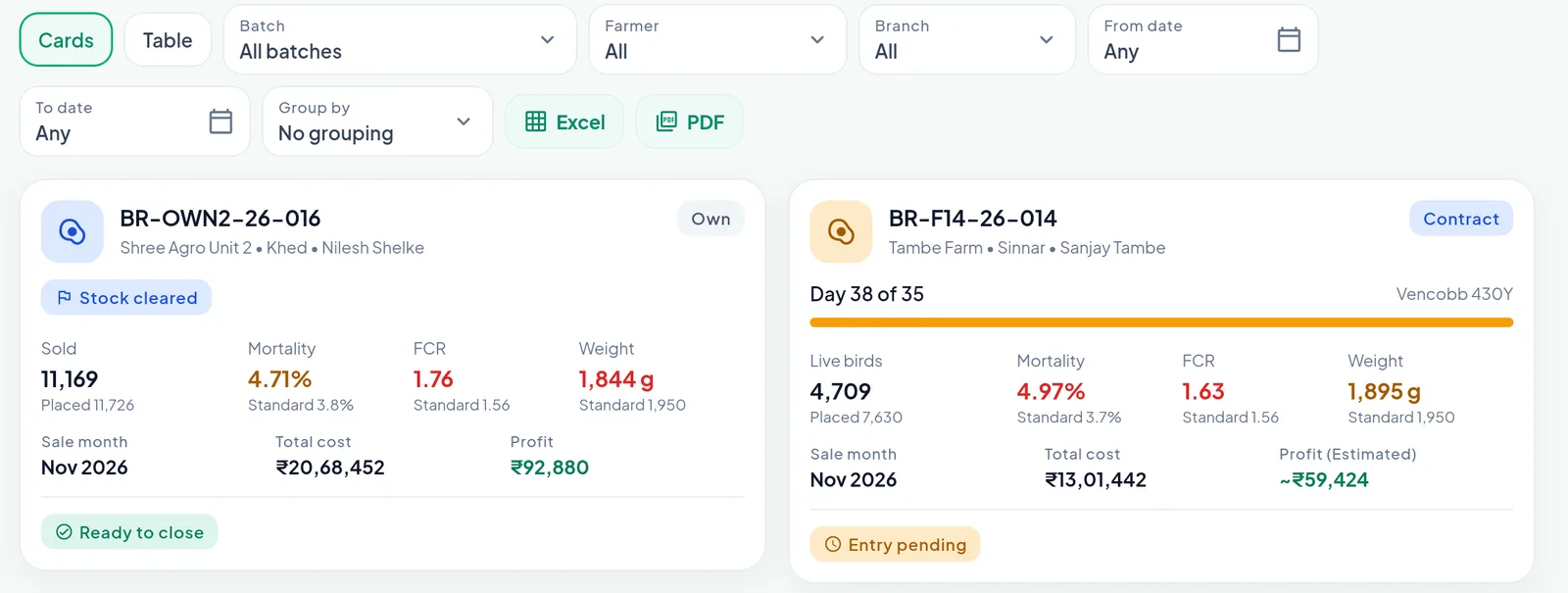
The own batch made ₹92,880 on ₹20,68,452 of cost; Tambe Farm is estimated at about ₹59,424.
A batch counts in the month of its sales. The Table view groups by branch or farmer and compares this month with the previous month and with the same month last year, and the financial year to date with the same span of last year. Only sold batches count in a comparison, and a forecast counts in none.
The costing report: one batch, day by day
The Costing report takes one batch and lays out its cost day by day: the birds opening, the mortality, the culls, the sales and the birds closing; the feed in kg; the opening bird cost, the feed, medicine, vaccine and overhead costs of the day; the cost of the mortality and the culls; the cost of the birds sold; the closing bird cost and the closing cost per bird. The closing of one day is the opening of the next.
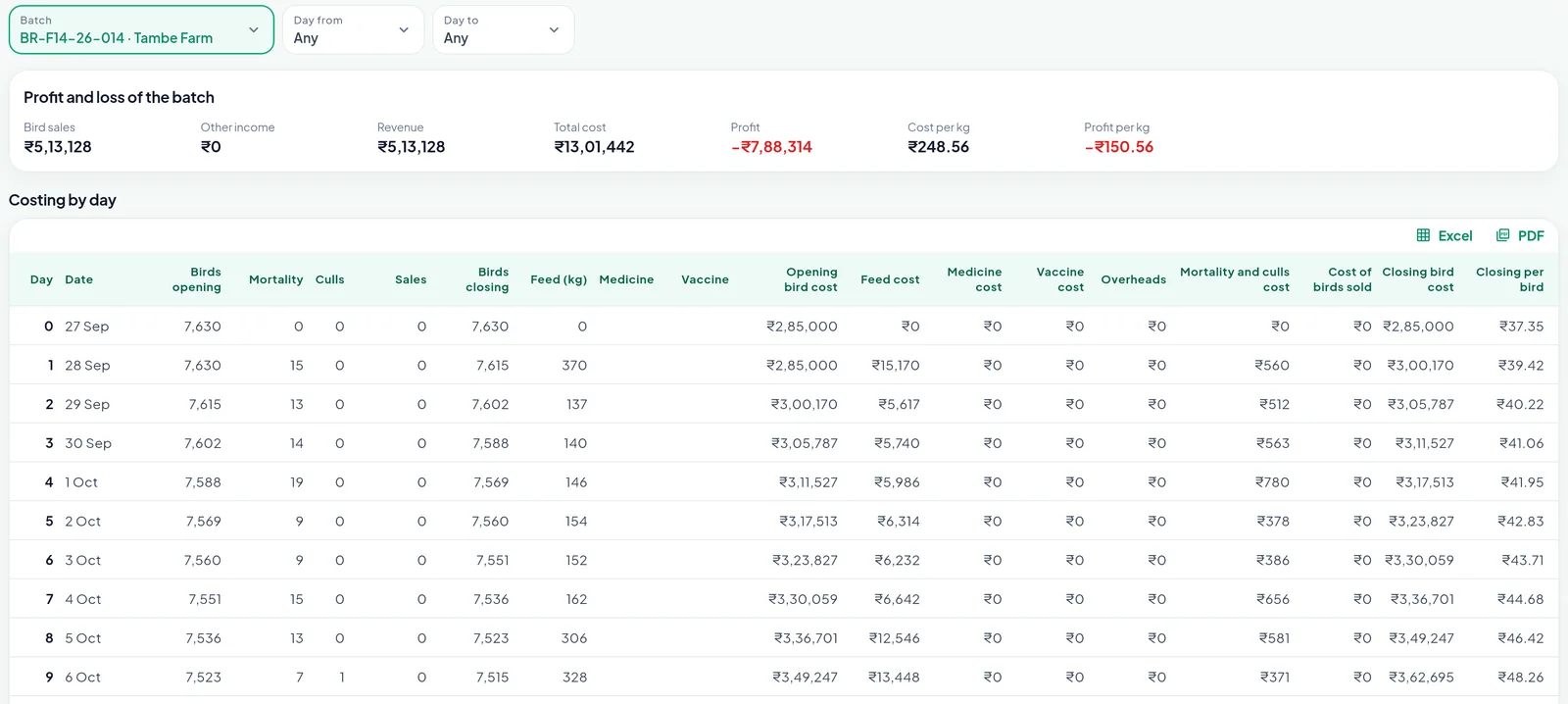
Day 0: 7,630 chicks at ₹2,85,000, ₹37.35 a bird. By day 9 each bird carries ₹48.26.
Follow bill S-1001 into it. On day 37, Tambe Farm opened with 7,256 birds, lost 12 and sold 2,535 to Al Noor. The birds sold left at the opening cost of the day, ₹172.39 each, which is the ₹4,37,004 in the column Cost of birds sold. The 4,709 birds that stayed carry ₹8,64,438, or ₹183.57 a bird. The mortality of the day is costed at the opening rate, ₹2,069 here, shown and not deducted.
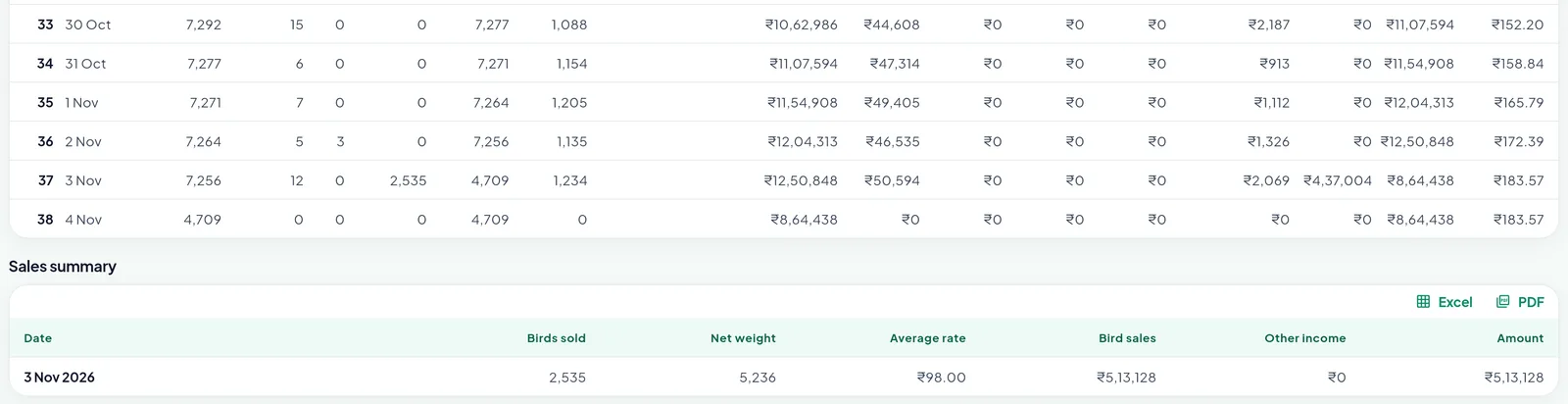
Bill S-1001 as the costing report sees it: 5,236 kg at ₹98, ₹5,13,128.
That is why the profit at the top reads minus ₹7,88,314. The report sets the ₹5,13,128 of one sale against ₹13,01,442, the whole cost to date. The profit and loss card of the same batch shows the estimate for all its birds, about ₹59,424. The two do not disagree: one counts what is sold, the other what the batch should end at.
Purchases, expenses and growing charges
The Purchase and expense register lists every bill by supplier, expense head and batch, with the amount, what is paid, the approval and how the bill is spread over the batches.
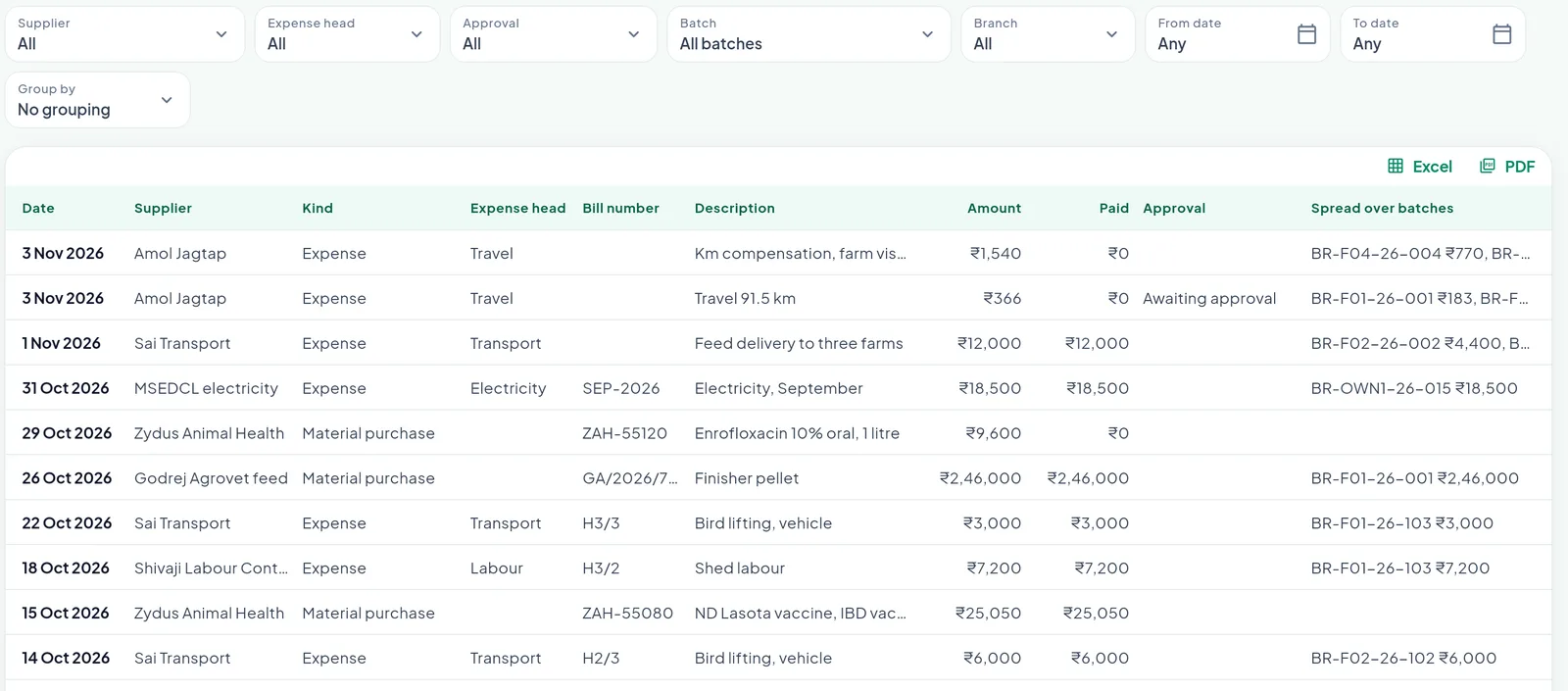
A supervisor’s 91.5 km of travel, ₹366, waits for approval and counts in no cost until then.
A supervisor’s travel for the day lands here with Awaiting approval. The filter Approval shows what waits, and the Owner or the Manager approves it with a click on the row. Until then it counts in no batch cost, no costing report and no profit.
The Growing charge register shows every step of the farmers’ statements: live kg sold, FCR, the production cost per kg, the growing charge per kg and the growing charge, with the supervisor of each farm.
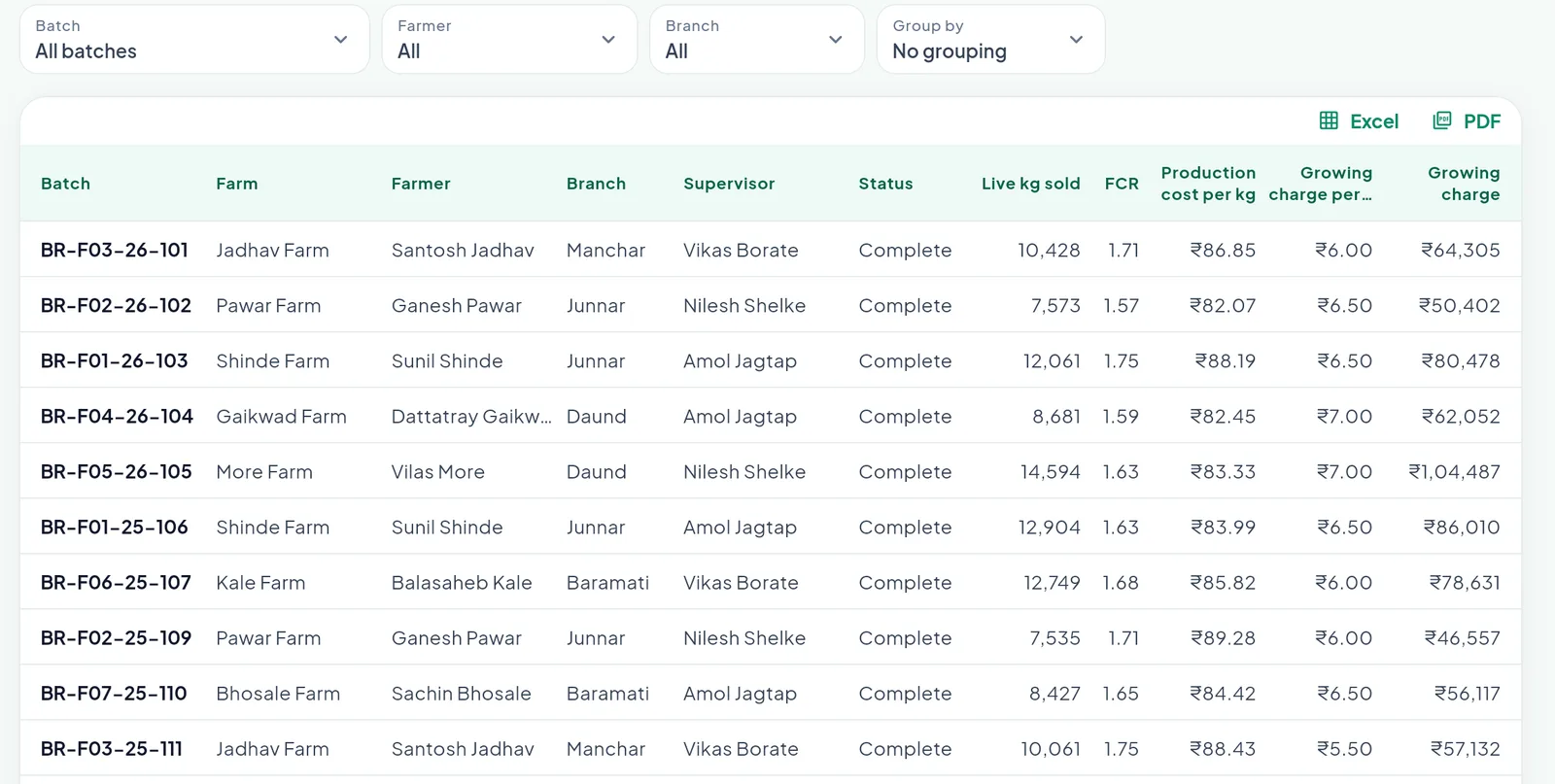
Pawar Farm made its kg at ₹82.07 with an FCR of 1.57; Shinde Farm’s BR-F01-26-103 at ₹88.19 with 1.75.
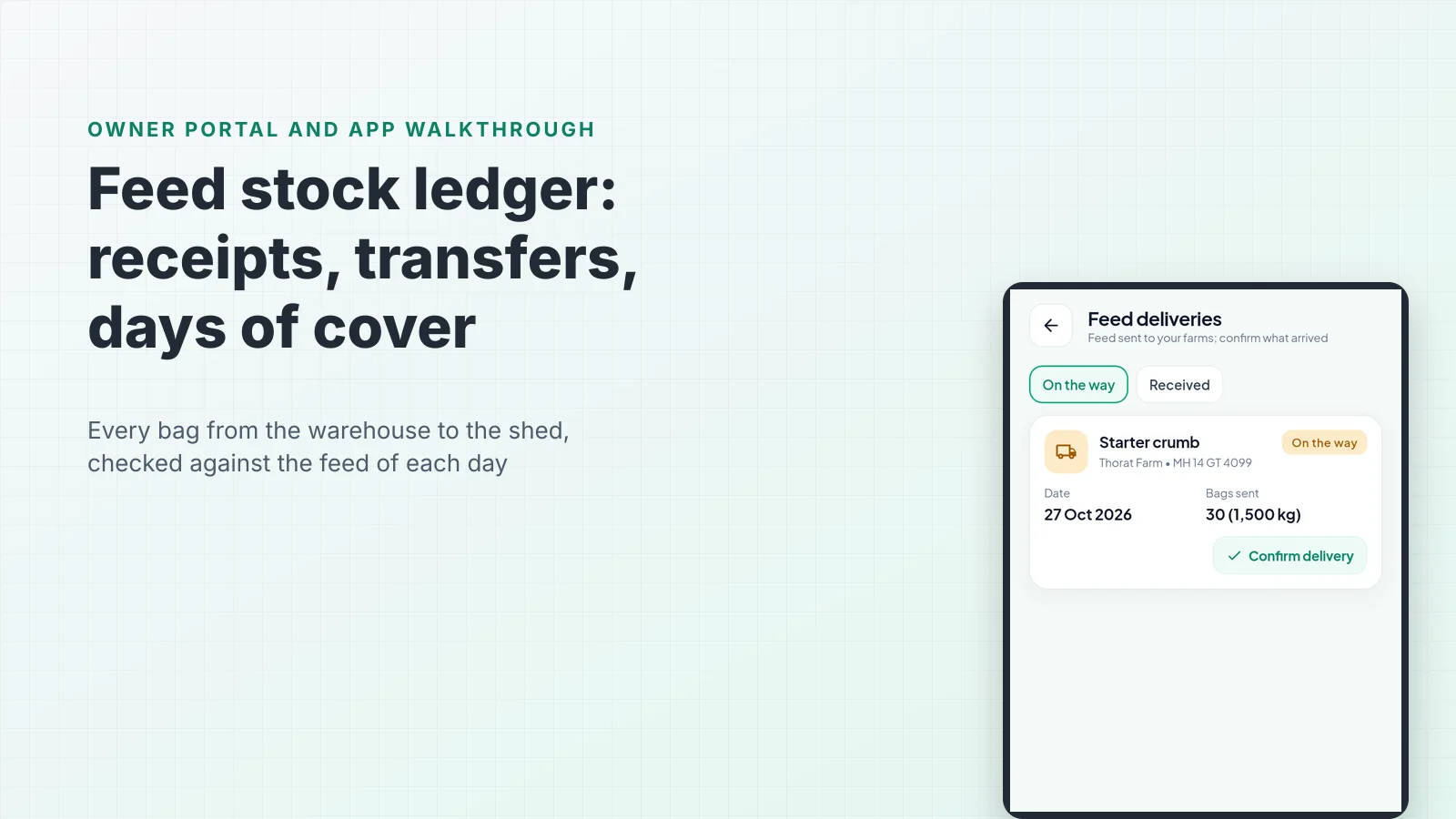
How each figure is reached is in our post on growing charges in contract broiler farming. The Feed stock register is the subject of the feed stock ledger.
Excel and PDF, as the screen stands
Every register has Excel and PDF at the top right, and both stay in view when a wide table scrolls sideways. They export the register as it stands: the dates, the filters and the grouping on the screen are the rows in the file, with the totals. The Excel file comes from PoultryOS’s own writer and opens in Excel. Every PDF carries the PoultryOS logo, the font of the screens and the rupee sign; in Hindi, Marathi and Tamil the PDF pages are pictures of the table.
At the month end the accounts team sets the dates to last month, presses Excel on the sales, purchases, growing charges and feed stock, and PDF on the profit and loss: one file per register, no retyping. A row of the other registers opens its batch, so a figure that looks wrong is one click from the entries behind it.
Frequently asked questions
Can I export a register to Excel from the phone? No. The app shows the registers condensed and shares a register as PDF from the share icon. The full registers, with every filter, the grouping and the Excel button, are on the Owner portal.
Does the Excel file hold what I filtered? Yes. Excel and PDF export the register as it stands on the screen, with the filters and the grouping applied and the totals. PoultryOS writes the Excel file itself, and it opens in Excel.
How is the FCR of a branch worked out when a register is grouped? From totals, not from an average of ratios. The FCR of a group is all its feed over all its live kg, and its mortality all the birds lost over all the birds placed, so a small batch does not weigh as much as a large one.
Why does the costing report show a loss for a batch that is still selling? The costing report counts the birds sold so far against the whole cost of the batch to date. The birds still in the shed carry their cost in the closing bird cost of the last day. The profit and loss register shows the estimate for the whole batch beside it.
Can a Vet open the profit and loss or the sales registers? No. The Vet sees no money in PoultryOS: the Reports page of the portal does not offer the money registers to that role, and the app hides the money figures too.
See your own registers
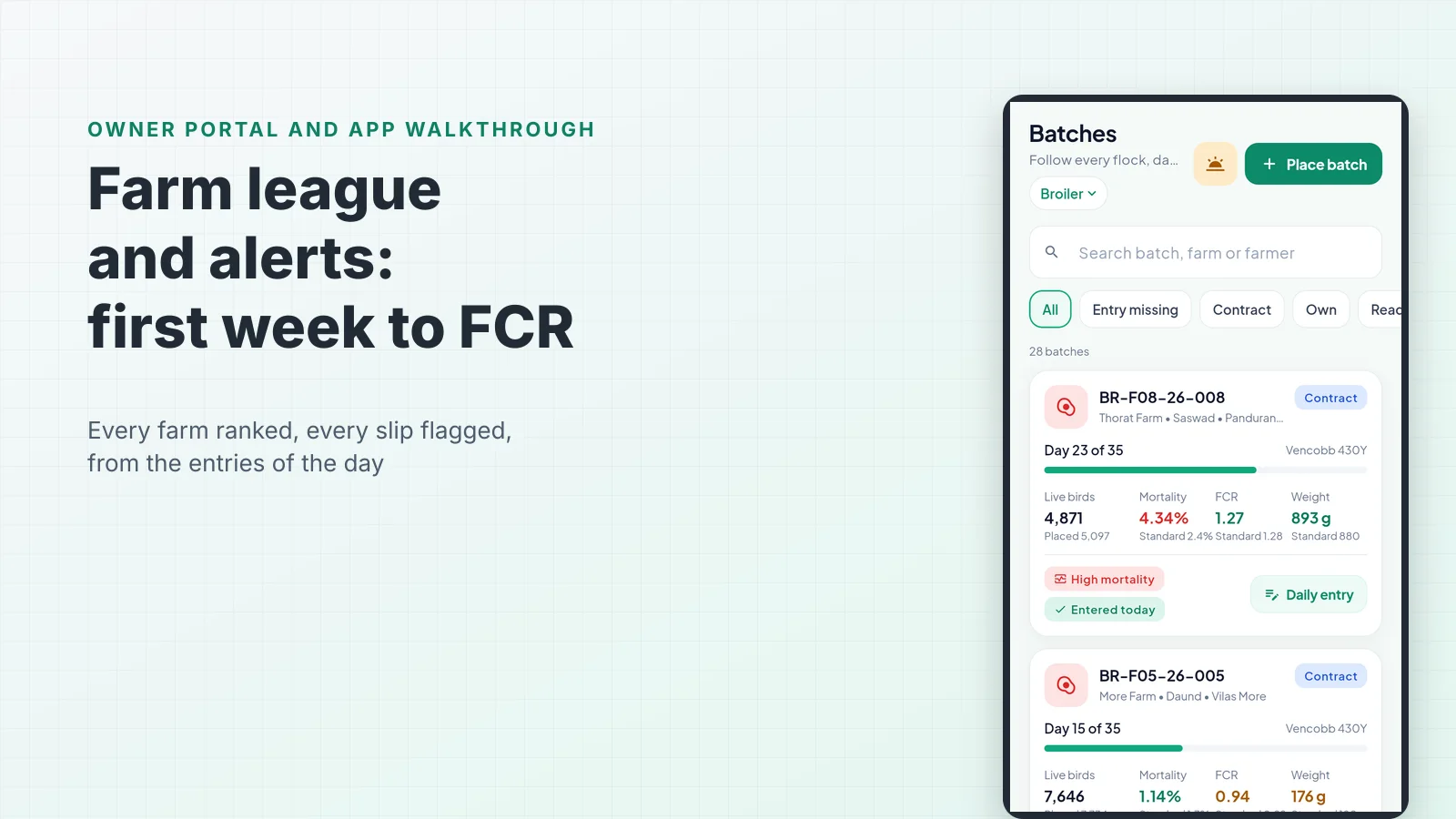
The best test is your own farms. Book a demo and we will set up a sandbox organisation with your farms, so you can export your own sales book and outstanding from poultry management software your supervisors already fill from the phone. The Contract Broiler Farming (CBF) Software module page shows the whole batch cycle, and the earlier posts cover the batch P&L the same day and the farm league and alerts, the views that read the same figures. A sheet records the month; a poultry ERP closes it.