
Growing charges: how PoultryOS settles a contract broiler batch
A walkthrough of the growing charge scheme, the statement every farmer can read on the phone, and the register owners use to settle hundreds of batches without a dispute.
PoultryOS Team · Product and implementation team
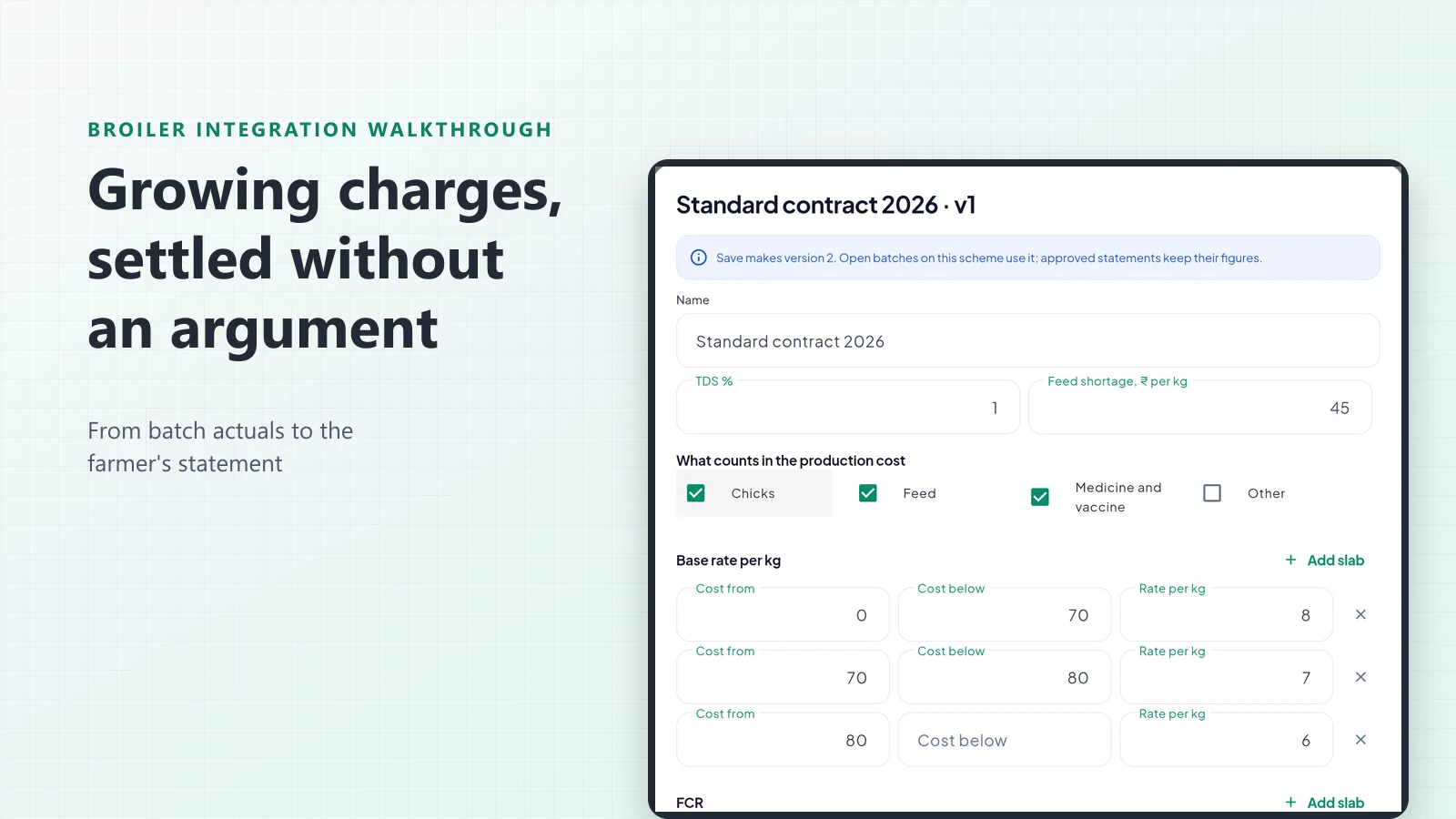
Ask any broiler integrator where the arguments happen, and growing charges come up first. The farmer remembers the birds he lifted; the branch remembers the feed it sent; the accountant has a spreadsheet that agrees with neither. The scheme itself is rarely the problem. The problem is that the numbers feeding it arrive late, from three different registers, and the statement is typed up weeks after the shed has been washed.
PoultryOS moves the whole chain into one record. The scheme is a master the owner controls. The batch actuals come from the daily entries supervisors already make on the phone. The statement writes itself as the batch runs, the farmer can read it on his own phone, and the owner approves it once, after which nothing in it can change. This post walks through that chain, screen by screen, with a real example from the demo organisation.
What a growing charge scheme holds
Every organisation keeps its own schemes under Masters, Growing charge schemes in the owner portal. The list shows each scheme’s version, the range of base rates it can produce, the TDS it applies, and how many open batches currently run on it.
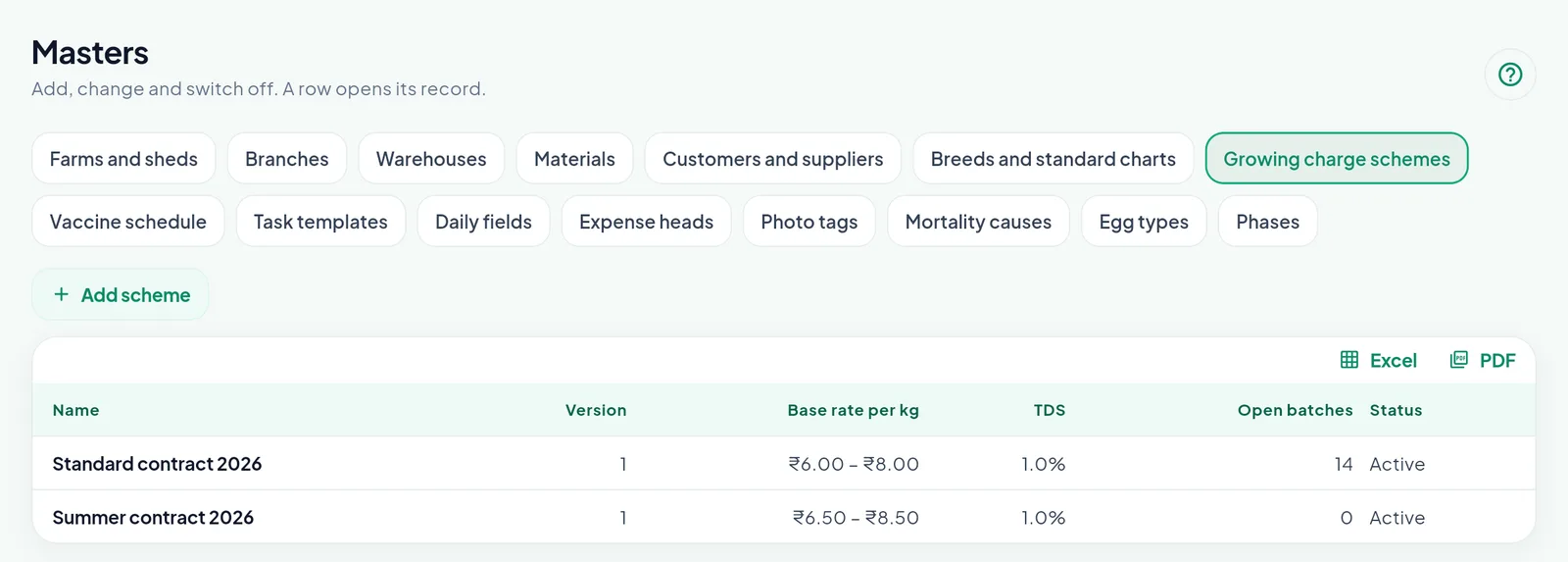
Two schemes in the sample organisation. Fourteen open batches run on the standard contract.
Open a scheme and the editor shows the parts that decide what a farmer is paid:
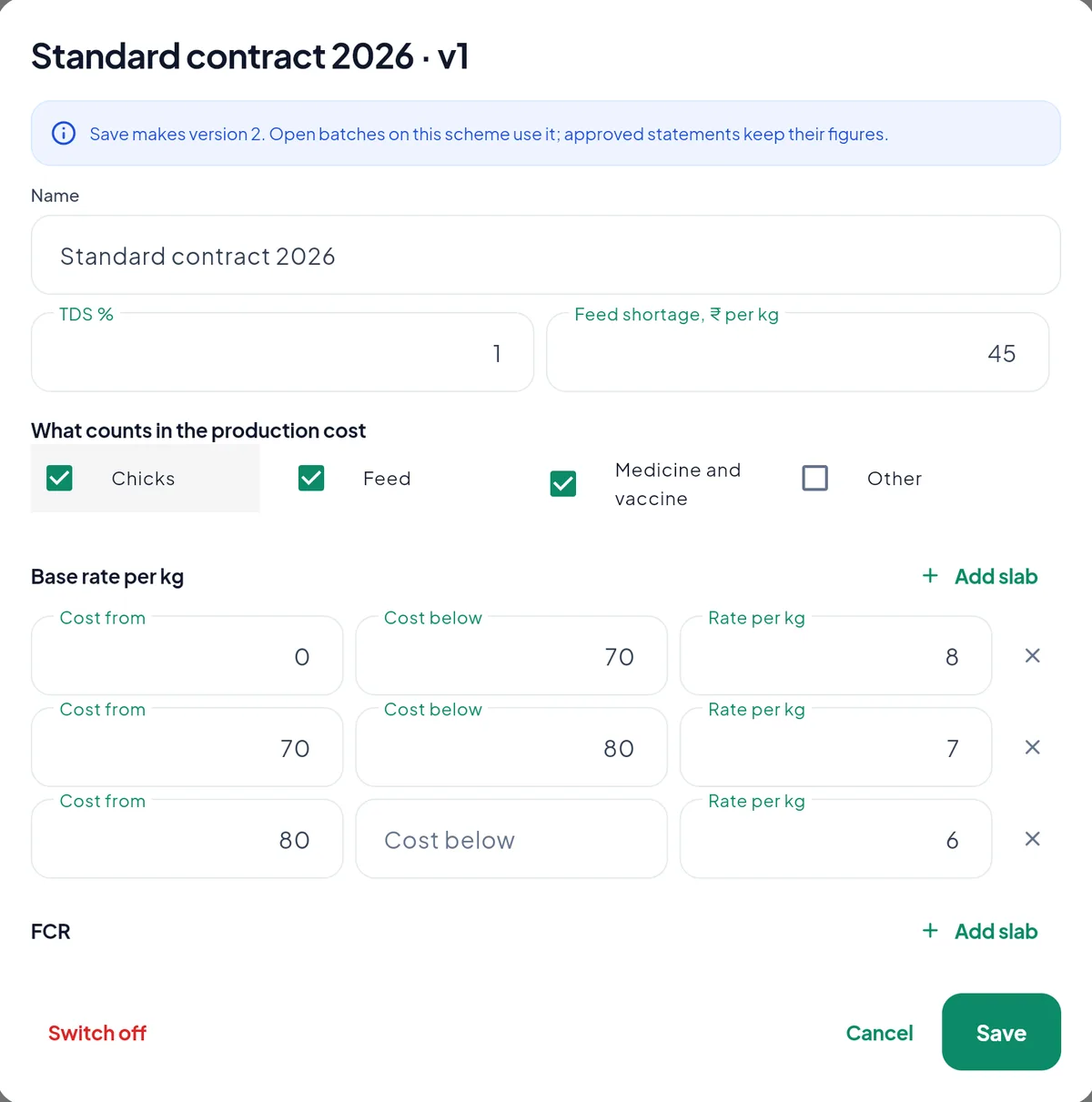
The editor for “Standard contract 2026”. A save creates version 2; open batches move to it, approved statements keep their figures.
- What counts in the production cost. Tick boxes for chicks, feed, medicine and vaccine, and other expenses. Production cost per kilogram is the sum of the ticked costs divided by the live kilograms sold. This is the single most argued number in a settlement, and here it is a setting, not an opinion.
- Base rate slabs. Production cost from and below, giving a base rate per kilogram. In the sample scheme a batch that cost under ₹70 per kg earns ₹8.00, between ₹70 and ₹80 earns ₹7.00, and ₹80 or above earns ₹6.00.
- Parameter slabs for FCR, mortality and BPI. Each row is a range with an incentive or a deduction, and a basis: per kilogram, per bird, or a percentage of the base rate. The sample scheme pays an extra ₹1.00 per kg below an FCR of 1.55, ₹0.50 between 1.55 and 1.65, nothing up to 1.75, and deducts ₹0.50 above that. Mortality under 4 % earns ₹0.50 per kg; over 6 % loses it. A BPI of 300 or more earns ₹0.50 per bird.
- Deductions. Bird shortage by slab, applied step by step: in the sample, the first 20 birds short cost ₹200 each, the next 30 cost ₹300, and anything beyond ₹400. Feed shortage is a rate per kilogram, ₹45 here. TDS is a percentage, 1 % here.
Only the owner adds or changes schemes. A change never rewrites history: it becomes the next version, open batches follow it, and a statement that has already been approved keeps the figures it was approved with. A scheme with an open contract batch cannot be switched off, and one scheme is always active. New organisations start with a platform default that the PoultryOS team maintains, so the first contract can be placed on day one.
The batch supplies the actuals
A contract batch takes its scheme at placement. From then on the daily entry does the rest. Supervisors record mortality, feed and weights on the phone; sales are booked against the batch; and the figures a settlement needs, birds placed and sold, live kilograms, feed consumed, mortality, average weight, mean age at sale, FCR and BPI, are the same figures the owner has been watching all along on the batch page.
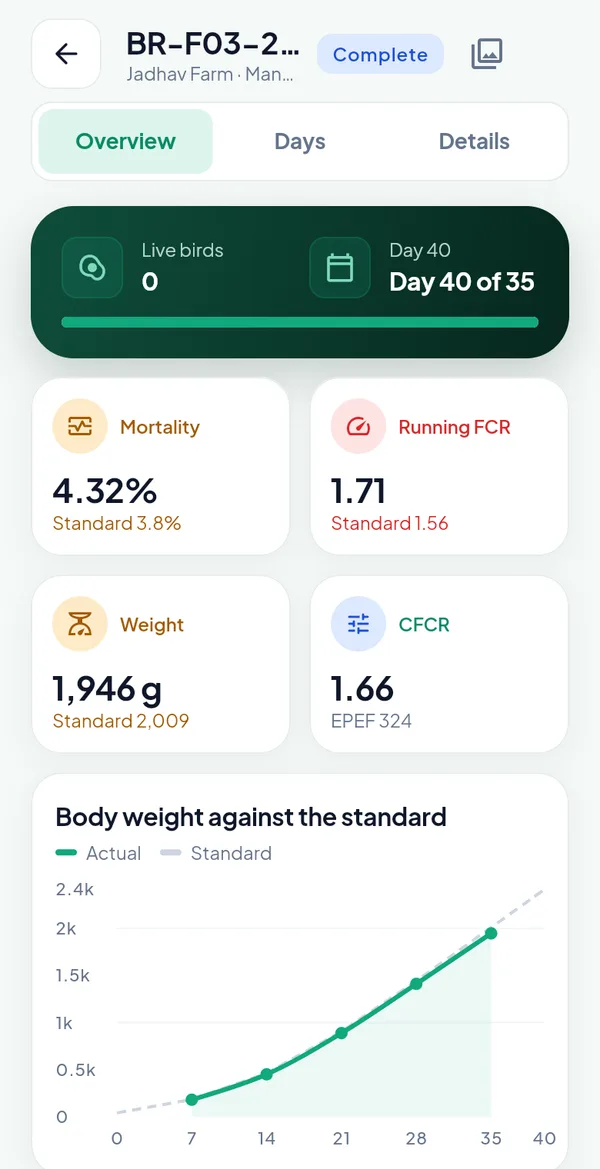
Batch BR-F03-26-101 on Jadhav Farm, complete. The actuals that go into the statement were built up one daily entry at a time.
The Details tab of the batch holds the way into the statement, next to the batch’s sales and its closure, and shows the cost breakdown that the production cost is computed from.
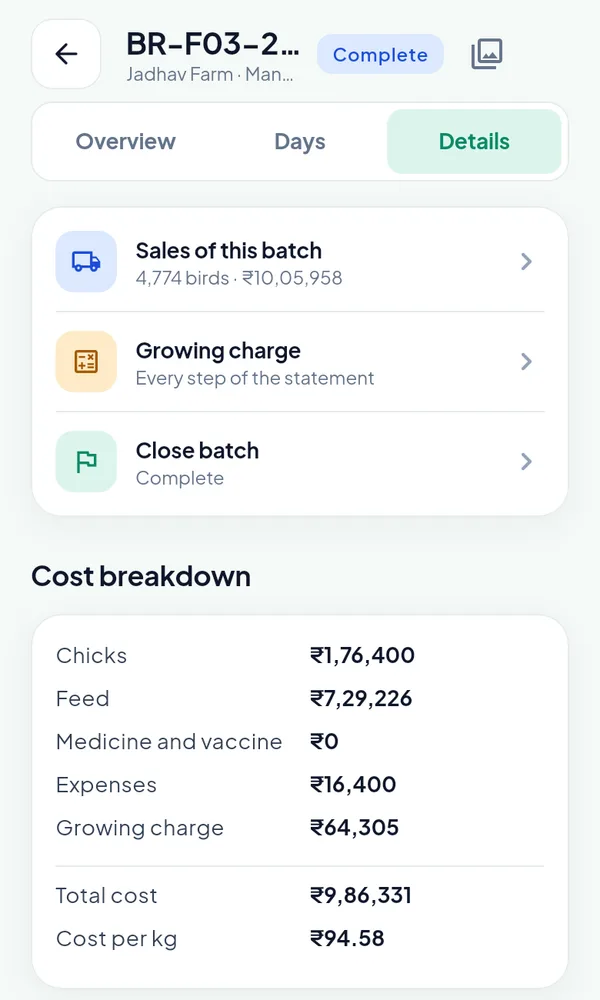
The cost breakdown of the same batch. Once approved, the growing charge itself becomes part of the batch cost and of its profit.
The statement, line by line
Open Growing charge and the statement reads top to bottom the way an accountant would check it. Here is the sample batch, settled under the standard scheme.
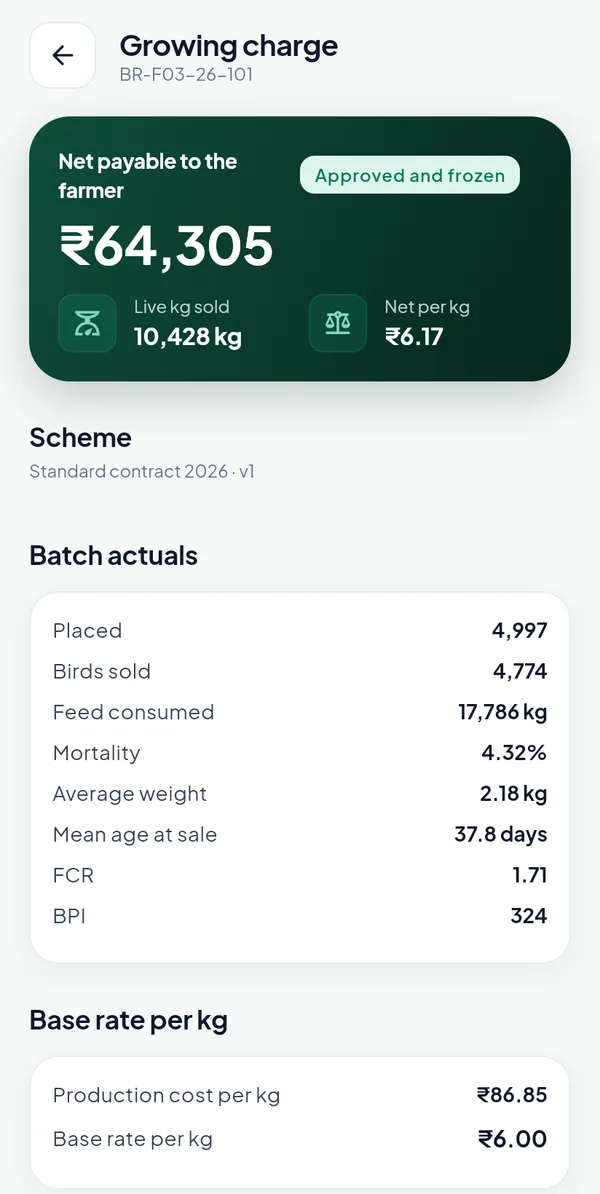
The top of the statement. The badge says “Approved and frozen”: these figures can no longer change.
Batch actuals. 4,997 chicks placed, 4,774 birds sold, 10,428 kg live weight, 17,786 kg feed, 4.32 % mortality, 2.18 kg average weight, mean age at sale 37.8 days, FCR 1.71, BPI 324. BPI, the broiler performance index, combines livability, weight, age and FCR into one number, so a scheme can reward an all-round good batch rather than one figure.
Base rate. The counted costs of this batch work out to ₹86.85 per kg, which falls in the ₹80-and-above slab, so the base rate is ₹6.00 per kg.
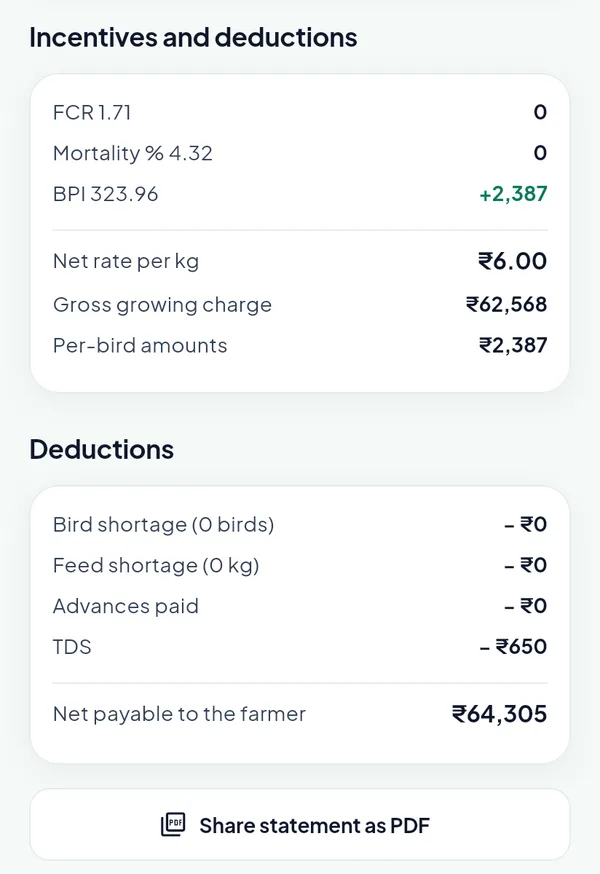
The bottom of the statement. Every incentive, deduction and the TDS has its own line.
Incentives and deductions. FCR 1.71 sits in the neutral slab, so ₹0. Mortality 4.32 % also sits in the neutral slab, ₹0. BPI 324 clears 300, so ₹0.50 per bird on 4,774 birds sold: ₹2,387. The net rate stays ₹6.00 per kg; the gross growing charge is ₹6.00 × 10,428 kg = ₹62,568, plus the per-bird ₹2,387.
Deductions. No birds short, no feed short, no advances. TDS at 1 % on ₹64,955 is ₹650.
Net payable to the farmer: ₹64,305, which the statement also expresses as ₹6.17 per live kilogram sold, the figure most farmers compare across integrators.
The same statement exists as a PDF, one tap away, with every one of these lines on it.
Approve, freeze, pay, close
A contract batch closes through fixed steps that only move forward: sales complete, stock cleared, growing charge approved, farmer paid, closed. Own-farm batches skip the two growing charge steps.
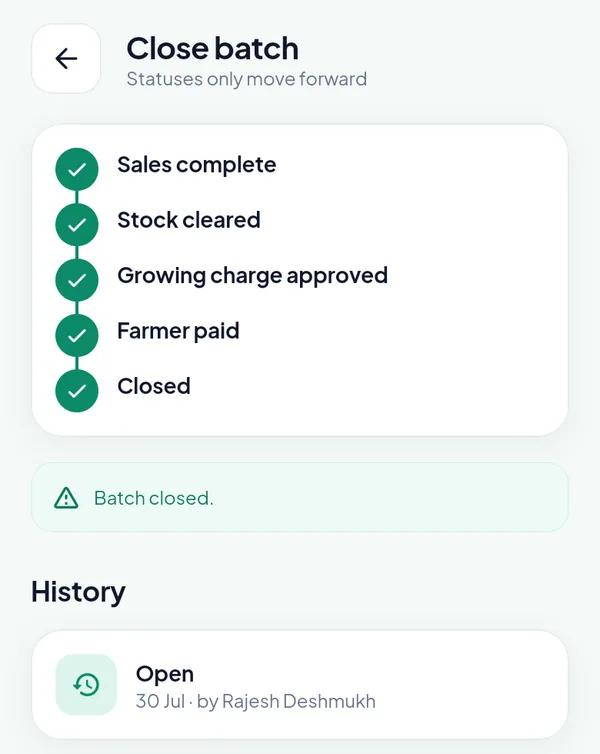
A closed contract batch. Each step records who did it and when.
Two of those steps feed the deductions. Sales complete needs no live bird left on the book; any bird still on the book is the shortage. Stock cleared takes the feed counted on the farm; with the feed stock ledger on, the book stock less the count is the feed shortage, and it leaves the stock as an adjustment and lands on the statement in the same movement. There is no second data entry and no later reconciliation.
Until approval the statement is a live draft: every new entry or sale changes it. The owner approves it from the closure screen; that freezes the inputs. The payment to the farmer is then recorded with its amount and mode, cash, UPI, bank or cheque, and the batch moves on to closed.
What the farmer sees
The contract farmer has the same statement in his own app, from the day the batch is placed. While the batch runs it carries the badge “Draft, changes with the entries”; after approval it carries “Approved and frozen”. He can share the PDF from his phone.
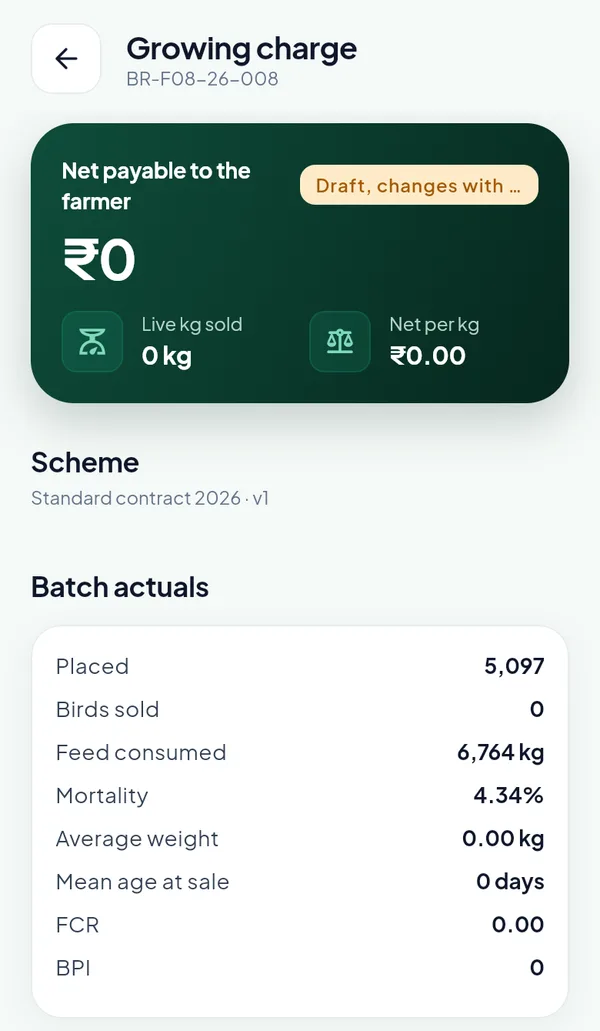
A statement early in a batch, on the farmer’s phone. Nothing has been sold yet, so the payable is still zero, but the scheme and the actuals are already visible.
This is the part that ends most arguments before they start. A farmer who can watch his FCR slab move during the batch does not learn about it from an invoice six weeks later.
Settling hundreds of batches: the register
For the owner and the branch accountant, the Growing charge register under Reports lists every statement with its actuals, the production cost per kg, the rate per kg and the growing charge, filterable by batch, farmer and branch, and groupable by farmer or branch for totals. Excel and PDF export the register as it stands.
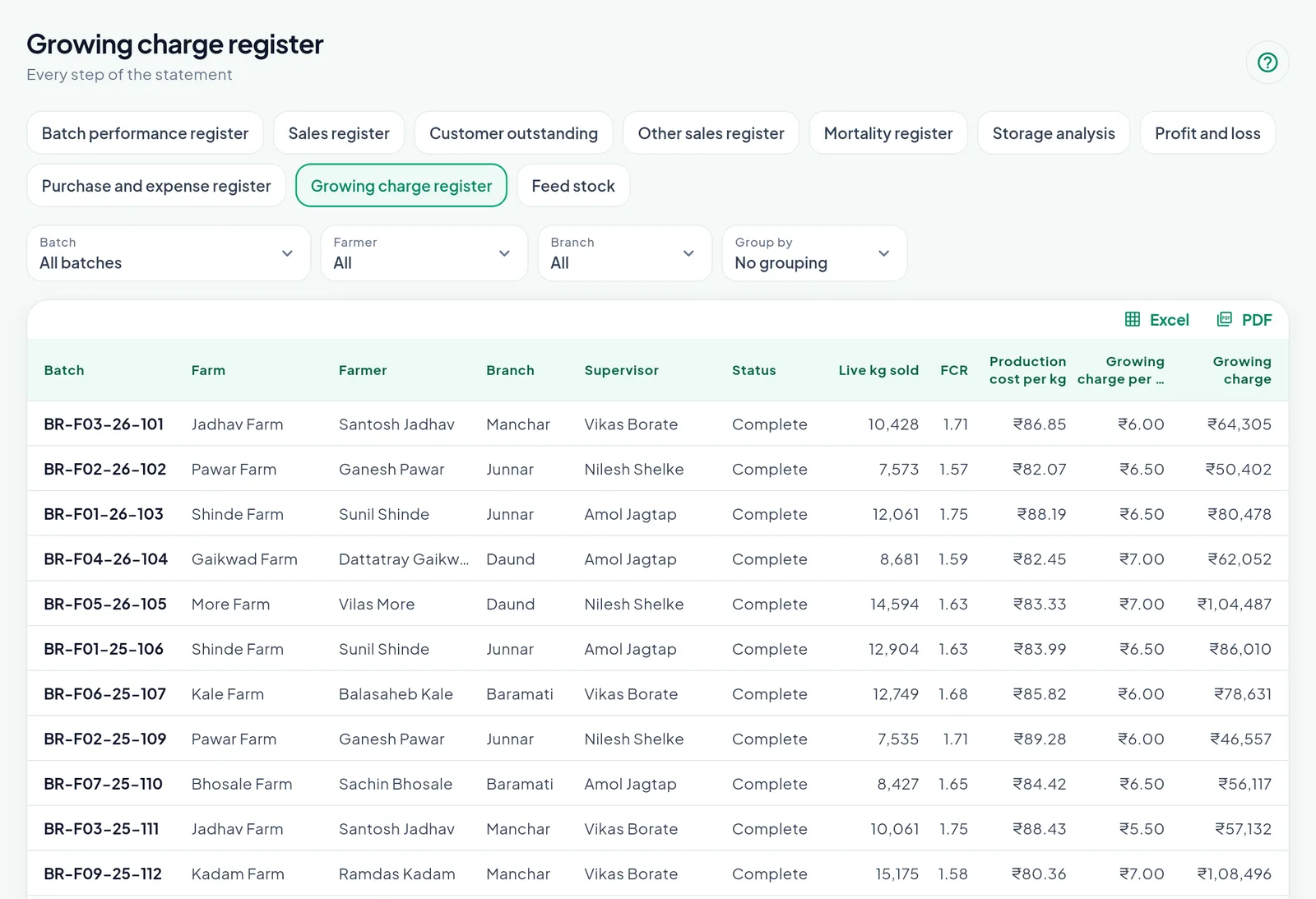
The register across branches. Rates in this sample run from ₹5.50 to ₹7.00 per kg, which is exactly the spread the scheme was designed to produce.
Approved growing charges flow into the money pages too. The Financial page shows growing charges paid beside sales, receivables and purchase spend, and every batch’s profit includes its growing charge in the total cost.
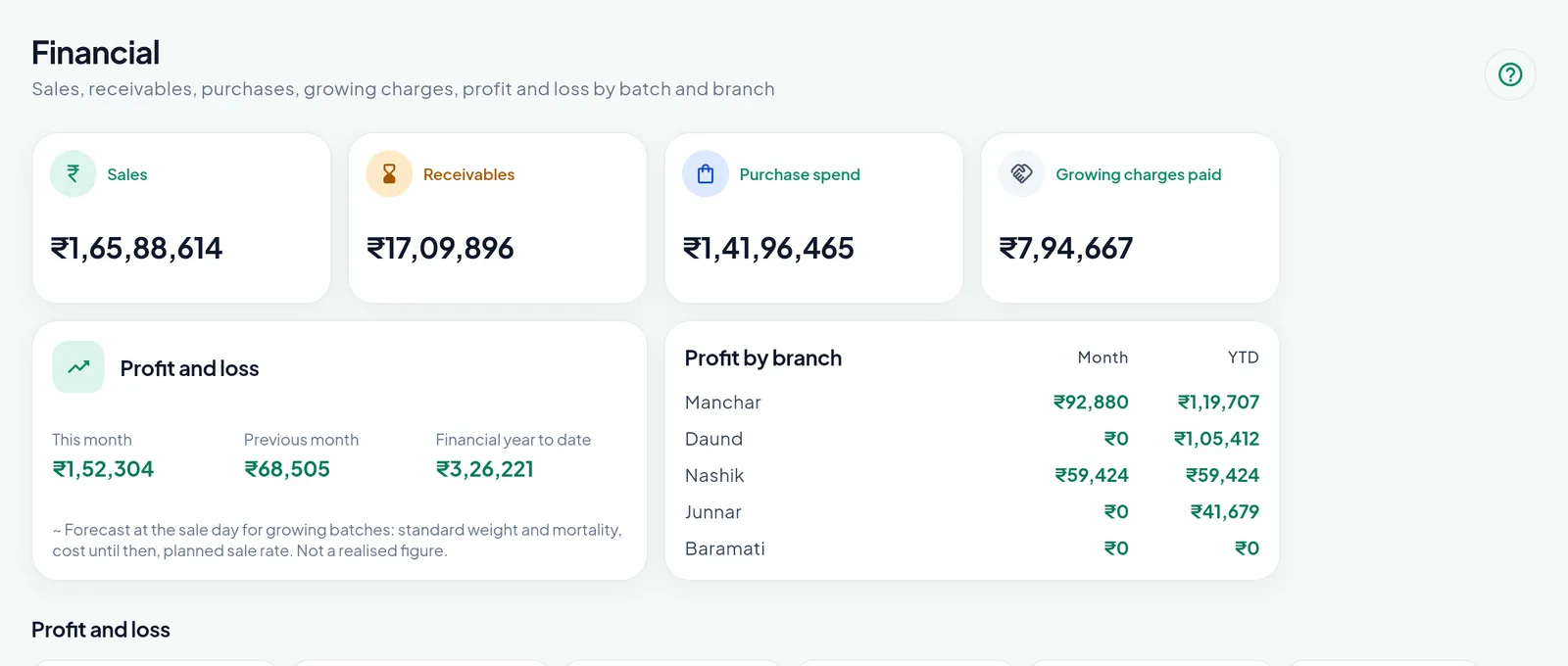
Growing charges paid as a tile on the Financial page, with the profit by branch that depends on it.
Why this design, in one paragraph
A settlement is a calculation on top of facts. PoultryOS keeps the calculation as a versioned, owner-controlled master, collects the facts once at the point where they happen, and lets everyone who is affected read the result before it is final. The cost basis is a setting, the slabs are visible, the shortages come from the stock ledger rather than from memory, and an approved statement is immutable. Everything else, the PDF, the register, the branch totals, falls out of that.
Frequently asked questions
Can a scheme change in the middle of a batch? Yes, and it is handled deliberately. Saving a scheme creates a new version. Open batches on that scheme follow the new version; statements that were already approved keep their old figures. If you want a batch to stay on the old terms, place it on a separate scheme.
Can an integrator run several schemes? Yes. Each batch picks its scheme at placement, so a summer scheme with a higher base rate can run beside the standard one.
Does the farmer see the statement before approval? Yes, as a draft marked as such. Many integrators consider this the main benefit: the farmer sees the same numbers the branch sees, while there is still time to correct an entry.
How are advances and TDS handled? Both have their own lines on the statement. TDS is a percentage set in the scheme and is deducted from the gross after the shortage deductions.
What about own farms? An own-farm batch has no growing charge and skips the two settlement steps in the closure. Its cost and profit are computed the same way, without the growing charge line.
See it on your own numbers
The scheme in this post is the sample one. Yours will have different slabs, and the point of the walkthrough is that they can be entered as they are. If you run contract broiler farming, book a demo and bring one real settlement; we will put it through the scheme editor with you. The module page for Broiler Integration Management describes the rest of the workflow, from placement to branch P&L, and the overview for integrators shows how it fits with breeder, hatchery and feed mill operations.