First-week mortality is the earliest warning your batch will give you
The first seven days decide more of a broiler batch than any other week. Here is what the mortality number is telling you, why it needs to reach the manager the same day, and what to check before day two.
PoultryOS Team · Product and implementation team
Every integrator has a first-week mortality threshold. Most record it faithfully. Far fewer act on it inside the week, because the number travels from a register to a supervisor’s notebook to a spreadsheet at the branch and arrives after the window to fix anything has closed.
Why the first week matters more than the rest
Chicks placed into a shed are finishing development that started in the hatchery. Their immune system, gut and thermoregulation are immature. Mistakes in brooding temperature, water access, feed access or ventilation during these days do not only kill the weak birds. They set back growth in the survivors, and that shows up as poorer uniformity, lower seven-day weights and a worse final FCR.
Across the industry, a seven-day weight that misses target rarely recovers fully by lifting. That is why a first-week mortality figure above threshold is an early signal for the whole batch, not just a count of dead birds.
What the number is usually telling you
Mortality in the first week comes from a short list of causes, and the pattern of the deaths points at the cause.
- High in the first 48 hours, then falling: chick quality or transport. Look at hatchery and delivery conditions, yolk sac condition and dehydration.
- Rising from day three onwards: brooding environment. Check litter temperature, draughts, humidity and whether chicks are spreading evenly or huddling.
- Clustered in one part of the shed: local equipment. A blocked drinker line, a failed brooder or a cold corner.
- Steady and above standard on every farm in a branch: something upstream. A feed batch, a vaccine lot, or a placement from the same hatcher.
Separating these needs the mortality figure next to the environment readings and the placement record, on the day, for every farm in the branch.
What to check before the end of day two
- Crop fill. A sample of chicks a few hours after placement should have soft, full crops. Empty crops mean the birds have not found feed or water.
- Litter temperature, not air temperature. Chicks live at floor level. Measure where they are.
- Chick behaviour. Evenly spread, quiet, feeding and drinking is right. Huddling is cold. Panting and spreading to the walls is hot. Noise is usually thirst or cold.
- Water line pressure and nipple height. Eye level on day one, raised as birds grow.
- Record the number the same day. A mortality figure recorded on day five and reported on day nine is a history lesson, not an alert.
From register to alert
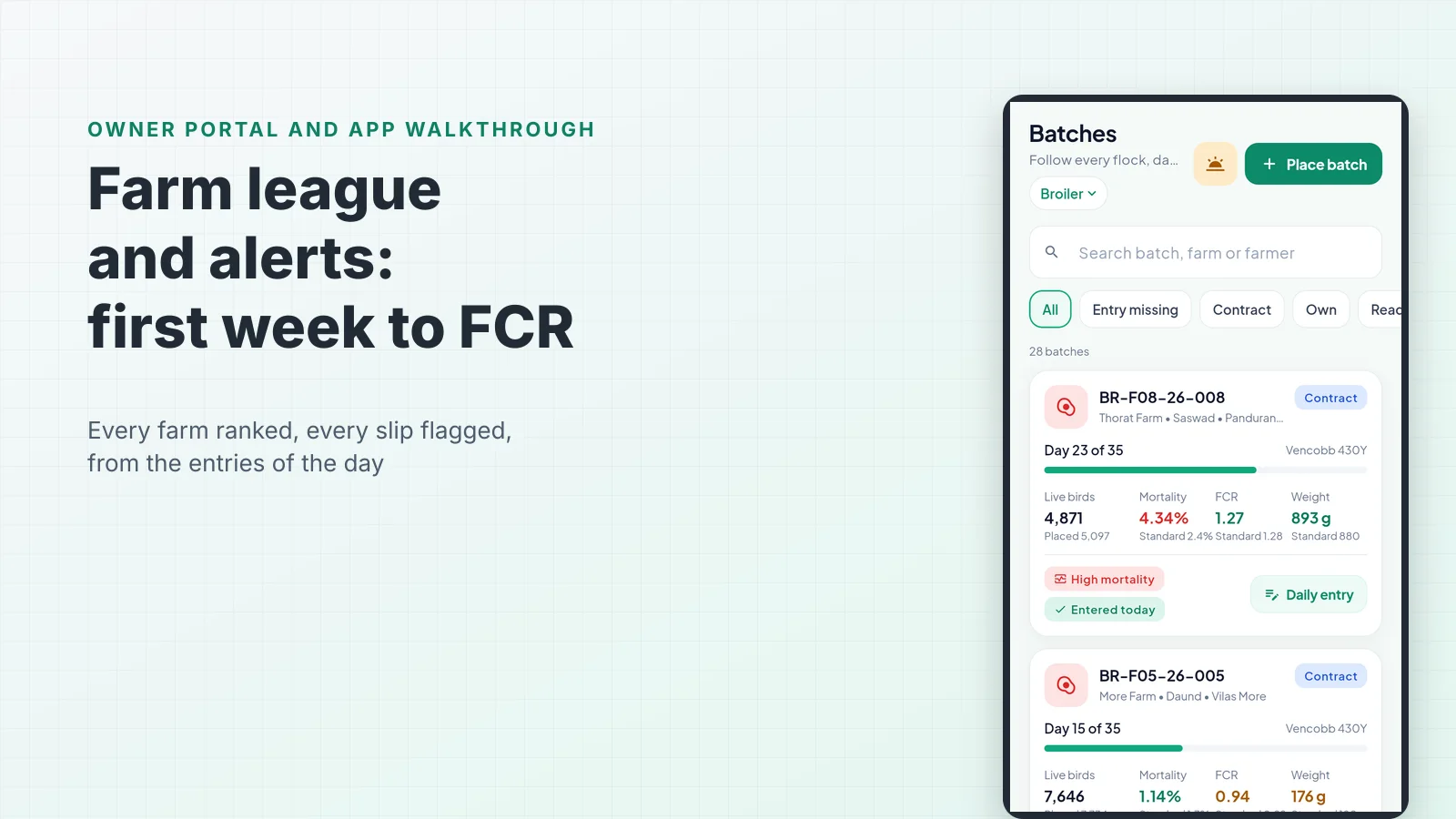
This is where the data flow matters more than the data. In PoultryOS the supervisor records mortality on the mobile app in the shed. The system compares it to the breed standard for that age, and if it crosses the threshold set for the scheme, it raises an alert to the branch manager and the vet before the supervisor has left the farm. The farm rating and supervisor feedback sit next to it, so the manager sees whether this farm has history.
None of that replaces the supervisor’s judgement. It just makes sure the judgement is applied on day two instead of at batch close.
If you want to see how alerts and first-week tracking work on your own numbers, schedule a demo.